Paid and organic landing pages were once treated as completely separate entities. One for campaigns, one for SEO, different teams, different tools. That separation made sense when paid CPAs were more predictable.
Rising competition on paid channels, higher CPMs, and tighter attribution windows have changed the math for most teams. The logical response is getting those same landing pages to pull organic traffic, too.
Most of them can’t, and the reasons are usually the same three things: hosted on generic subdomains, disconnected from the rest of the site, and carrying just enough content to support a CTA but not nearly enough to satisfy a search engine.
This guide covers how to fix all three without sacrificing the conversion rates you’ve already worked hard to build. It will explain how you can build SEO landing pages that not only rank but also convert.
Key takeaways
- Publish to your own domain. SEO authority built on a subdomain disappears the moment you move the page.
- Put your CTA above the fold. Put your SEO content below it. Both goals live on the same page.
- One page, one keyword. Pick a transactional term and map it to your title tag, H1, URL, and image alt text.
- Check Core Web Vitals before you publish. LCP under 2.5s, INP under 200ms, CLS under 0.1. Fix what fails.
- Never rebuild a seasonal page from scratch. Keep it live year-round and let the authority compound.
- Use 302 redirects when A/B testing indexed pages. A 301 transfers ranking authority to your test variant permanently.
What is an SEO landing page?
An SEO landing page is a standalone web page created and optimized to rank in organic search results while converting visitors into leads or customers. It does two jobs at once: it satisfies a search engine’s need for crawlable, substantive, relevant content, and it guides the visitor toward a specific action.
If you’re new to the format, this overview of what a landing page is covers the fundamentals.
That dual purpose is what makes SEO landing pages different from the minimal, conversion-focused pages typically built for PPC campaigns.
A PPC landing page is designed for a narrow, controlled audience. It’s often kept off the search index entirely (via a noindex tag), features minimal navigation, and exists to convert paid traffic that already knows why it clicked.
💡Pro Tip: Instapage addresses each problem directly: custom domain publishing keeps SEO authority on your own domain. AI Content generates copy variations within the builder so pages have enough substance to satisfy search engines. Experimentation runs server-side A/B tests so you can optimize conversion rates as organic traffic grows.
An SEO landing page, by contrast, needs to earn its audience from cold. It has to appear in search results, communicate relevance instantly, and then drive the same conversion.
| SEO Landing Page | PPC Landing Page | |
|---|---|---|
| Indexed by Google | Yes | Often no (noindex) |
| Internal links | Connected to site architecture | Usually isolated |
| Content depth | Substantive, supports search intent | Minimal, supports paid ad message |
| Navigation | May include header/footer | Typically stripped |
| CTA count | One primary CTA with supporting content below fold | One focused CTA |
| Lifespan | Long-term / evergreen | Campaign-driven |
| Goal | Rank and convert organic traffic | Convert paid traffic |
Many teams build both versions, or use a hybrid approach where the same page serves organic and paid traffic by structuring content so the conversion elements appear above the fold and the SEO content lives below it.
The strategic case for SEO landing pages is straightforward: paid CPA tends to rise over time, while organic traffic compounds. A well-optimized SEO landing page that ranks for a relevant search term can generate leads for months or years with no ongoing ad spend behind it.
What Google looks for in an SEO landing page
Google’s ranking systems are built around one question: does this page genuinely help the person who searched for this term? That framing (Google calls it the “people-first” approach) shapes everything from what content you write to how your page performs technically.
A few signals matter most for landing pages specifically.
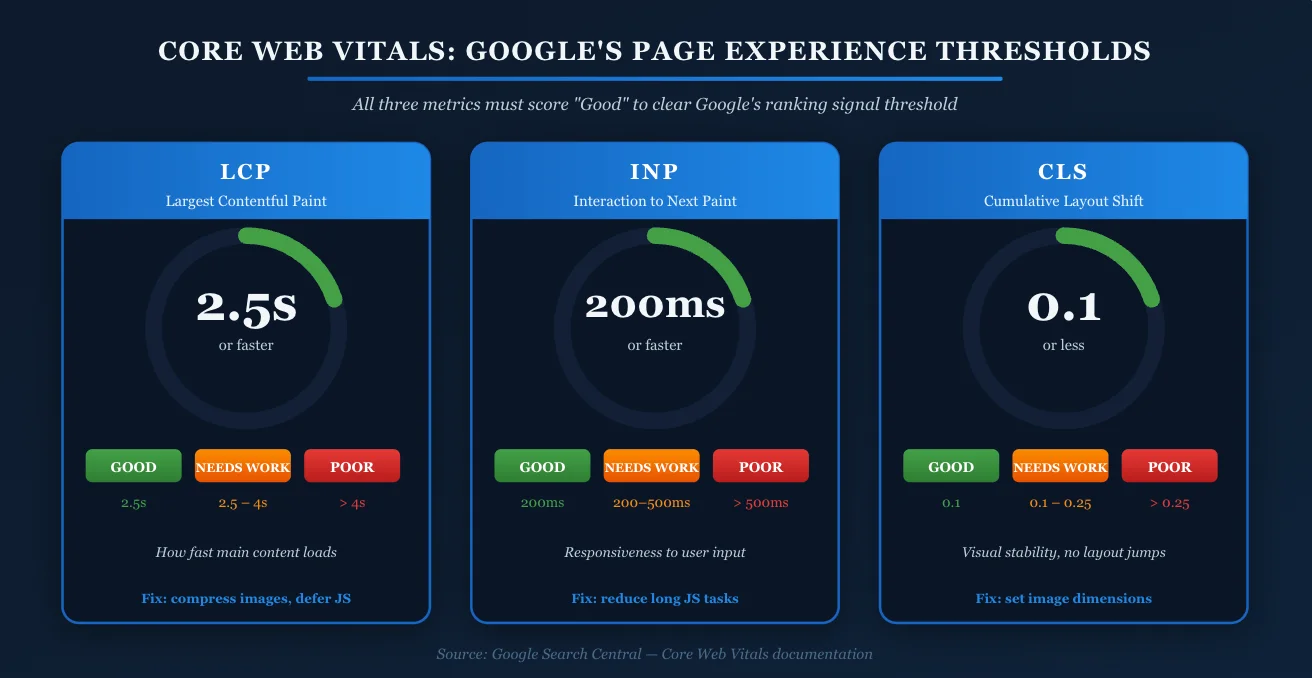
Core Web Vitals. Google uses three page experience metrics as confirmed ranking signals: LCP (how fast main content loads, target under 2.5s), INP (responsiveness to user input, target under 200ms), and CLS (visual stability, target under 0.1). Pass all three, and you clear a meaningful technical bar. Fail any of them, and rankings suffer regardless of content quality.
Mobile-first indexing. Google uses the mobile version of your page to index and rank it. Full stop. If your landing page hides key content, images, or CTAs behind mobile-specific breakpoints, or if the mobile version loads more slowly than the desktop version, that gap directly affects how the page is assessed.
💡Pro Tip: Instapage's builder automatically generates a mobile version as you design for desktop, with elements pre-aligned for mobile layouts. The grouping and aspect ratio lock feature lets you control exactly how complex arrangements convert to mobile, so nothing collapses or disappears unexpectedly.
Crawlability and indexability. A page can’t rank if Google can’t access it. Make sure there’s no noindex tag on pages you want to rank, that the page isn’t blocked in your robots.txt, and that canonical tags point to the correct URL rather than inadvertently excluding the page from the index.
Content quality and depth. Google’s Search Essentials make clear that thin pages (those with little original content, heavy duplication, or that exist primarily to funnel visitors somewhere else) are unlikely to rank well. SEO landing pages need enough substantive content to fully address the searcher’s intent, not just enough to prop up a form.
Doorway page risk. If you’re creating many similar pages (say, one per city or one per product variant), be aware that Google penalizes pages designed primarily to rank for slight keyword variations without offering meaningfully different content. Each page needs to offer something genuinely useful and distinct to that audience.
How to build an SEO landing page that ranks and converts
1. Publish to your own domain
This is non-negotiable. When you publish a landing page to a generic subdomain like yourbrand.pagebuilder.com, any search authority the page accumulates stays there, not on your site. The moment you move or recreate the page, that authority is gone.
Publishing to your own custom domain (e.g., yoursite.com/your-landing-page) means every backlink, every indexed URL, and every crawl signal contributes to the domain you own. Instapage supports custom domain publishing natively, so this doesn’t require a separate hosting setup.
2. Research and map your keywords
Keyword research is the foundation of any SEO landing page strategy. The most effective approach for landing pages is to target transactional, bottom-of-funnel keywords: terms that indicate the searcher is close to making a decision, not just browsing for information.
Start by building a list of terms relevant to your offer, then narrow to long-tail variants that reflect specific intent. A personal injury attorney in New York is better served ranking for “car accident lawyer Brooklyn free consultation” than competing against national aggregators for “car accident lawyer.” Long-tail keywords are less contested, easier to rank for, and typically convert at a higher rate because the searcher’s intent is more specific.
A few practical rules to follow:
- Map one primary keyword to each page. Trying to rank a single page for multiple unrelated terms dilutes its focus.
- Use secondary and semantically related keywords throughout the page naturally. Google’s understanding of language means you don’t need to repeat an exact phrase to signal relevance. Related terms and synonyms reinforce it.
- Check search volume and difficulty using tools like Google Search Console, Ahrefs, or Semrush before committing to a keyword target.
Once you’ve identified your primary keyword, Instapage AI Content can generate headline, paragraph, and CTA variations directly inside the builder, so you can populate page sections quickly without starting from a blank page.
3. Place keywords in the right on-page elements
Once your keyword is selected, placement determines how clearly you signal relevance to search engines. Here’s where it counts:
Title tag. This is the clickable headline that appears in search results. It should include your primary keyword, ideally near the front, and be written to earn the click rather than just satisfy an algorithm. Keep it under 60 characters to avoid truncation in SERPs.
Meta description. This doesn’t directly influence rankings, but it directly influences click-through rate. Use it to communicate the specific value on the page in under 160 characters. Include the primary keyword naturally.
H1 heading. There should be one H1 per page and it should contain your primary keyword. Every H2 and H3 beneath it can incorporate secondary or semantic keywords.
Image alt text. Google can’t see images. It reads the alt text you provide. Descriptive alt text that reflects what the image shows (and, where relevant, includes a keyword) helps both search engines and accessibility tools.
Body copy. Keywords should appear naturally in the page content. There’s no magic density target to hit. What matters is that the page reads like it was written for a person, not an algorithm. If keyword placement feels forced, it probably is.
URL slug. Keep it short, descriptive, and keyword-containing. yoursite.com/seo-landing-pages is better than yoursite.com/page?id=4872.
💡Pro Tip: Once you have the placement right, Instapage AI Content can generate multiple variations of your title tag, headline, and CTA copy directly inside the builder, so you can test which version earns more clicks without rewriting from scratch each time.
4. Write content that informs and converts
Here’s where most marketers get stuck: they assume adding content for SEO means burying the CTA under walls of text. That’s a false choice.
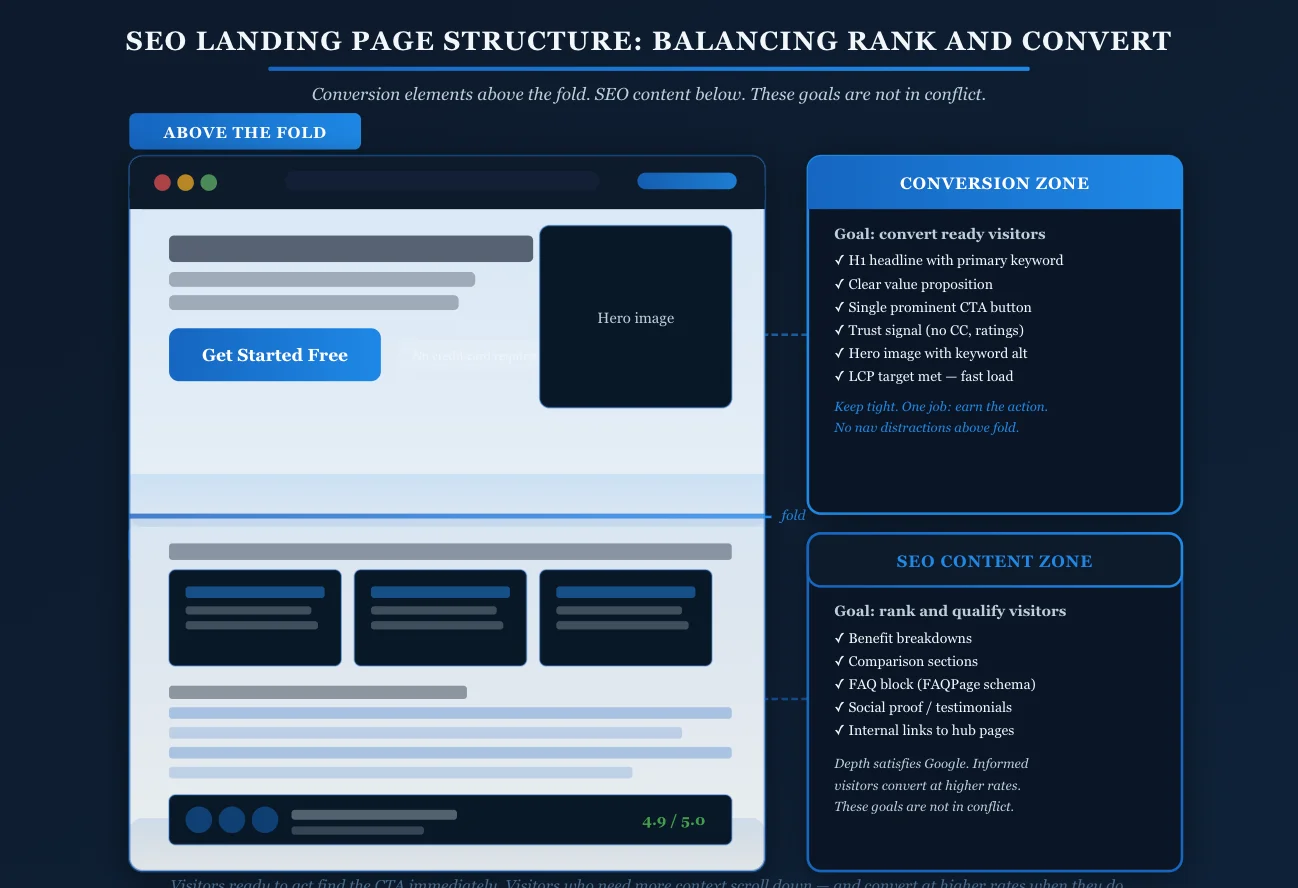
The solution is a simple structural principle: put your conversion elements above the fold, and put your SEO content below it.
Above the fold (the portion of the page visible without scrolling) should contain your headline, subheadline, the primary value proposition, and a clear call to action. This is where the conversion happens. It should be tight, compelling, and uncluttered.
Below the fold, you have room to add the substantive content that search engines reward: benefit breakdowns, FAQs, comparison sections, supporting statistics, use cases, and customer proof.
💡Pro Tip: If you're starting from scratch, Instapage's landing page templates give you a conversion-tested structure to build on rather than designing the layout from zero.
Original content carries additional value for backlink acquisition. Pages that contain proprietary data, original research, or tools that others in your industry want to reference attract inbound links naturally, which signals authority to Google and supports rankings.
5. Optimize for Core Web Vitals and page speed
Page speed has been a ranking signal for years. Core Web Vitals (LCP, INP, and CLS) formalized and expanded that signal in 2021. Getting these scores into the “good” range is now table stakes for competitive SEO.
Practical ways to improve each metric:
For LCP (target: under 2.5 seconds):
Compress images before upload and serve them in next-gen formats like WebP. Eliminate render-blocking scripts. Prioritize loading the above-fold content first by deferring non-critical JavaScript.
For INP (target: under 200ms): Minimize long JavaScript tasks that block the main thread. Avoid loading heavy third-party scripts (chat widgets, tag managers, tracking pixels) synchronously.
For CLS (target: under 0.1):
Always specify explicit width and height dimensions on images and video embeds. Reserve space for ads and dynamic content so they don’t cause layout shifts when they load.
Use Google PageSpeed Insights to audit your pages and identify which issues are dragging down each Core Web Vitals score.
6. Build internal links into your page
One of the most overlooked SEO requirements for landing pages is internal linking, and it’s one of the most impactful.
An orphaned landing page (one with no internal links pointing to it from the rest of your site) is hard for search engines to find, crawled infrequently, and carries no link equity from the rest of your domain. Google’s own guidance makes clear that important pages should be reachable through internal links.
Two directions of internal linking matter:
- Links to your landing page from relevant blog posts, resource pages, or product pages on your site. These transfer authority from established pages to your newer or lower-authority landing page.
- Links from your landing page to supporting content elsewhere on the site. This creates a content web that helps Google understand the relationship between your landing page and related resources.
If you’re building SEO landing pages for location-based or product-based keywords, consider creating a hub page that links to all the individual pages in that cluster. This architecture signals topical authority and makes each page easier for search engines to discover and index.
💡Pro Tip: Instapage Collections is built for exactly this pattern: one template generates all the location or product variant pages, and each page links back to a shared hub, so the internal link structure is consistent across every page in the cluster.
7. Earn backlinks with original content
Backlinks remain one of Google’s most powerful ranking signals because they function as endorsements. A link from an authoritative, relevant site tells Google that your page is worth referencing.
The most reliable path to earning backlinks is creating content that other people in your industry genuinely want to cite: original research, proprietary data, well-produced guides, free tools, or a unique perspective on a well-covered topic.
Tactics worth pursuing:
- Original data or surveys. Findings that don’t exist elsewhere give journalists, bloggers, and analysts a reason to link to your page as a source.
- Case studies. Real-world results, especially with specific metrics, attract links from practitioners looking to substantiate arguments.
- Targeted outreach. Identify writers and publishers who cover your topic area and reach out with a compelling reason to reference your page. The outreach itself is straightforward. The value of what you’re offering has to do the heavy lifting.
Not all links carry equal weight. A link from an authoritative industry publication moves the needle more than a link from a low-traffic, unrelated blog. Aim high, but build momentum incrementally.
8. Keep seasonal and evergreen pages live
Every time you tear down a landing page and rebuild it from scratch, you reset its SEO authority to zero. Every link it earned, every crawl signal it accumulated: gone.
UK electronics retailer Currys elegantly solved this problem. Since 2014, they’ve kept their Black Friday landing page live year-round. The URL stays consistent, the domain authority continues to compound, and when Black Friday arrives each year, the page is already primed to rank without having to claw back from zero.
If you run any annual promotions (Black Friday, end-of-year sales, seasonal product launches), apply the same principle. Keep the page live, update the content each season, and let the SEO authority compound over time.
The URL and the underlying relevance signals stay intact regardless of what’s on the page at any given moment.
9. Make your page mobile-first
Google indexes the mobile version of your page first. Whatever content, images, and CTAs exist on mobile are what Google uses to evaluate and rank the page. The desktop version is secondary.
That means any important content that only appears on desktop, any images that are hidden on mobile, or any CTAs that break on small screens are invisible to Google’s crawler. The mobile experience isn’t a stripped-down version of the page. It’s the canonical version.
Test your pages using Google’s Mobile-Friendly Test and PageSpeed Insights’ mobile tab to identify and fix issues before publishing.
10. Use structured data where applicable
Structured data (also called schema markup) is code you add to your page that explicitly tells search engines what kind of content they’re reading. It doesn’t directly cause rankings to improve, but it can enable rich results in SERPs that increase visibility and click-through rates.
For SEO landing pages, the most applicable schema types are:
- BreadcrumbList: helps search engines and users understand where the page sits within your site hierarchy.
- Organization/Logo: establishes brand identity for the domain.
- LocalBusiness: relevant for location-specific landing pages, adding address, hours, and contact information in a structured format.
- FAQPage: If your page includes an FAQ section, this schema can display those questions directly in SERPs. Note that Google has scaled back how often FAQ rich results appear, so implement it where relevant, but don’t count on it for visibility alone.
Ready to put this into practice? Build your first SEO-optimized landing page with Instapage. Instapage. Start your 14-day trial.
How to A/B test SEO landing pages without hurting rankings
A/B testing is essential for improving conversion rates, but if done incorrectly on indexed pages, it can create signals that confuse or penalize search engines. Here’s how to test safely.
Use 302 redirects, not 301s. When serving a test variant to a portion of visitors, a 302 (temporary) redirect signals to Google that the redirect is not permanent and should not affect how the original URL is indexed. A 301 (permanent) redirect would tell Google to transfer authority from the original URL to the variant, which is not what you want in a temporary test.
Maintain the canonical tag. Make sure both the original and variant pages point their canonical tag back to the original URL. This prevents variant pages from being indexed as separate pages or competing with the original.
Don’t cloak. Showing a different version of a page to Googlebot than to regular users is a violation of Google’s guidelines. The test needs to run consistently regardless of who’s visiting.
End tests promptly. Google’s guidance acknowledges that testing creates temporary signals that can look like manipulation if left running indefinitely. Conclude tests once you have statistically significant results.
💡Pro Tip: Instapage Experimentation supports server-side testing, which handles redirect logic and variant delivery correctly by default, so the risk of accidentally misconfiguring a split test is minimized.
How to scale SEO landing pages across locations and audiences
The opportunity to create SEO landing pages for multiple locations, product lines, or audience segments is significant. But it comes with a risk: Google’s doorway page policies specifically target pages created primarily to rank for slight keyword variations, where each page offers little value beyond the keyword change.
The difference between a legitimate scaled landing page strategy and a doorway page strategy lies in the content. A page targeting “accounting software for restaurants in Chicago” needs to contain genuinely useful, location-specific information, not just a template with the city name swapped in.
Practical ways to differentiate pages at scale:
- Include location-specific proof points, case studies, or statistics.
- Reference local context (regulations, market conditions, local businesses) where relevant.
- Customize the offer or messaging based on audience segment, not just the keyword.
💡Pro Tip: To generate unique content at scale, Instapage AI Content can produce keyword-aligned copy variations for each page, accelerating production without sacrificing the content differentiation that keeps pages on the right side of Google's quality guidelines.
Once the pages are live, Instapage Personalization lets you serve different experiences to different segments of that organic traffic based on attributes like industry, company size, or returning visitor status, so the conversion layer adapts to who’s reading, not just what they searched for.
How to measure SEO landing page performance
Optimization without measurement is guesswork. Here’s a practical goal-to-KPI framework for tracking SEO landing page performance across the funnel.
| Goal | KPIs to Track |
|---|---|
| Organic visibility | Keyword rankings, organic impressions (Google Search Console), indexed pages |
| Traffic acquisition | Organic sessions, click-through rate from SERPs |
| Conversion efficiency | Conversion rate, form submissions, cost-per-lead (blended with paid) |
| Page experience | LCP, INP, CLS scores (PageSpeed Insights / Search Console Core Web Vitals report) |
A few notes on interpreting these metrics:
Keyword rankings fluctuate, especially in the first months after a page is published or updated. Look for directional trends over 60 to 90-day windows rather than reacting to week-to-week changes.
Organic CTR from Google Search Console is an underutilized signal. A page that ranks on page one but has a low CTR is often a title tag or meta description problem. The page is visible, but not compelling enough to click. Small copy changes can produce meaningful CTR improvements without any additional ranking work.
Blended CPA (total spend across paid and organic divided by total leads) is the number that ultimately makes the business case for SEO landing page investment. As organic volume grows, blended CPA should decline even if paid CPA stays flat.
Core Web Vitals scores in Search Console’s Core Web Vitals report show field data (real user measurements) rather than lab data, which means they reflect actual visitor experience, not just a simulated audit. Field data changes slowly; expect a 28-day rolling window before new optimizations register.
Results will vary depending on traffic quality, keyword competitiveness, industry, and how rigorously the measurement and testing framework is maintained.
SEO landing pages are a system, not a checklist
SEO and conversion optimization are not competing priorities. They are sequential layers of the same system. Technical foundations come first: custom domain, Core Web Vitals, mobile parity, and internal links. On-page optimization comes next: keyword placement, content depth, and structured data.
Then, testing to validate that SEO changes are improving, not harming, conversion rates. And finally, scale, using templates and AI-assisted content to extend the strategy across locations, products, and audiences without rebuilding from scratch every time.
Landing pages that rank are not a different category from landing pages that convert. They’re the same pages, built with both goals in mind from the start.
If you’re ready to build SEO landing pages that do both, start a 14-day trial to see how the platform handles the technical and workflow overhead so you can focus on strategy.
Frequently asked questions
What is an SEO landing page?
A page built to rank in organic search and convert visitors into leads or customers. It does both jobs at once, unlike a PPC landing page which is designed purely to convert paid traffic.
Can landing pages rank on Google?
Yes, if they’re published on your own domain, contain substantive content that matches search intent, pass Core Web Vitals thresholds, and are connected to the rest of your site through internal links.
What are the best practices for SEO landing page optimization?
One keyword per page mapped to your title tag, H1, URL, and image alt text. Conversion elements above the fold, SEO content below it. Core Web Vitals in the green. Internal links to and from the page. A/B tests run with 302 redirects, not 301s.
How is an SEO landing page different from a PPC landing page?
A PPC page is isolated, often noindexed, and built exclusively to convert paid traffic. An SEO page is indexed, linked within your site architecture, and contains enough content to rank and satisfy organic search intent. Many teams use a hybrid structure that serves both.
How do you optimize a landing page for SEO without hurting conversions?
CTA above the fold, SEO content below it. Test changes with Instapage Experimentation using proper redirect practices so you’re validating improvements, not guessing.
How do you optimize a landing page for SEO without hurting conversions?
CTA above the fold, SEO content below it. Test changes with Instapage Experimentation using proper redirect practices so you’re validating improvements, not guessing.
Try the world's most advanced landing page platform with a risk-free trial.
