
AI search is changing how people discover brands. The next challenge for marketers is turning those AI search landing pages into actual conversions.
Search used to be simple. Someone typed a query into Google, scanned a list of results, and clicked an organic listing or an ad. They landed on a page, and the marketer had one shot to convert them.
That journey is changing. Google’s AI Overviews and AI Mode can pull information from several sources before showing an answer. Tools like ChatGPT and Perplexity search the web and cite their sources. Instead of starting with ten blue links, more people start with a question and get a synthesized answer.
So the most important question for marketers isn’t just “How do I rank in AI search?”
It’s “What happens after someone discovers my brand through AI?”
Because the click still matters. Once someone reaches your page, the job hasn’t changed: give the right person the right message, the right proof, and a clear next step.
That’s why landing pages are becoming more important in AI search, not less.

How is AI search different from traditional search?
Traditional search usually looks like this:
Query → Search results → Click → Landing page → Conversion
AI-assisted search adds more steps:
Question → Related searches → Synthesized answer → Cited sources → Click → Landing page → Evaluation → Conversion
That difference matters. Google explains that its AI features use a technique called “query fan-out.” The system runs several related searches across subtopics, then combines what it finds into one answer.
In practice, your customer may not find you by searching your exact product category. They might find you because your content answered a question several steps earlier in their decision.
A potential customer might never search “best landing page software.” Instead, they ask:
- “Why are my Google Ads getting clicks but not conversions?”
- “Should I send paid traffic to a dedicated landing page?”
- “How do I personalize landing pages for different campaigns?”
Each of those questions sits at a different stage of intent. And each one is a chance for your brand to be useful before the visitor ever reaches your site.
Do you need a separate AI SEO strategy?
It’s tempting to treat AI search as a whole new discipline. There’s plenty of talk about “AI SEO,” GEO (generative engine optimization), and AEO (answer engine optimization). Some of those ideas are useful lenses.
But be careful not to turn them into another checklist of hacks. Google’s guidance is direct: its AI features are built on the same core Search systems. There’s no special AI file, word count, or formatting trick that guarantees you’ll appear in an AI Overview. Google keeps pointing back to helpful, reliable, people-first content.
That’s good news. The winning strategy isn’t “optimize for machines instead of people.” It’s “create something worth discovering.”
Help search systems understand your page
There’s one technical step worth taking, and it isn’t a hack. Structured data (schema markup) tells search engines and AI systems who you are, what you offer, and what a page is about. Google uses it to understand content and power rich results.
With Instapage Schema Markup, you can add it from a page’s SEO settings without touching code. Pick a schema type such as Organization, Product, LocalBusiness, Event, or FAQPage, or choose Auto-detect. AI generates the JSON-LD, you validate it at schema.org, and it goes live the next time you publish.
Schema won’t rescue a weak page. It makes a strong page easier to read.
Stop thinking only in keywords. Start thinking in questions.
Traditional SEO starts with a keyword. That’s still useful. But AI search makes it more important to understand the problem behind the keyword.
The better question is: “What should we be the answer to?”
Take the keyword “landing page optimization.” Behind it sit dozens of different needs:
- Why isn’t my landing page converting?
- How much copy should a landing page have?
- Where should I put my CTA?
- Should my landing page match my ad?
- How do I personalize landing pages?
- How do I A/B test a landing page?
Those aren’t keyword variations. They’re different questions from people at different points in the buying journey. Brands that answer them well get more chances to enter the conversation. That beats publishing dozens of near-identical pages around slight keyword variations.
Weak approach: “10 Landing Page Optimization Tips”
Stronger approach: “Why Your Paid Traffic Isn’t Converting, and What to Fix After the Click”
The second topic ties directly to a real business problem.
Your landing page has a new job
Landing pages have always had one job: turn relevant traffic into action. That hasn’t changed. What has changed is the context people arrive with.
Someone clicking a paid search ad has usually seen a headline, a line of ad copy, and a URL. Someone arriving after an AI-assisted search may have spent several minutes researching first. By the time they click, they may have:
- compared different approaches
- read several recommendations
- picked up new terminology
- weighed alternatives
- formed expectations about what your product should do
They’re not landing on your page asking, “What is this?” They’re asking, “Is this actually right for me?” Your page has to reduce that uncertainty fast.
Message match matters more when the journey is longer
Imagine someone spends five minutes asking an AI tool: “How can I create more personalized landing pages for different paid campaigns?”
The AI suggests a few approaches. They click through to your site, and the first thing they see is:
“The world’s leading digital experience platform.”
Nothing is technically wrong with that headline. But it doesn’t answer the question that brought them there. Compare it with:
“Create personalized landing pages for every campaign, without rebuilding your site.”
Now the visitor knows instantly: I’m in the right place.
That’s message match. As search gets more conversational, the gap between the question someone asked and the message they land on becomes harder to ignore.
For paid search, Instapage’s AdMap® makes this gap visible. It connects your Google Ads campaigns to your landing pages, so you can see which ads point to which pages and spot mismatches before they cost you clicks.
Don’t build one page for everyone
AI-assisted discovery means people arrive at very different levels of intent. Consider three visitors:
The problem-aware visitor is researching why their campaigns aren’t converting. They need education, evidence, and a clear explanation of the problem.
The solution-aware visitor already knows they need dedicated landing pages. They need to understand capabilities, use cases, and what makes you different.
The decision-ready visitor is comparing vendors. They need proof, customer results, integrations, pricing, and answers to objections.
Sending all three to the same generic page leaves conversions on the table. The better question is: what does this visitor need to know next?
How to match the page to the intent in Instapage
You don’t need to rebuild a page for every audience. Instapage gives you two ways to do it.
Personalization lets you create multiple experiences on the same landing page URL. Each experience starts as a copy of your default design, and you can change as little as a headline or as much as entire blocks. Instapage decides which experience to show based on the URL parameters in your ad, either UTM parameters or an automatic parameter. Anyone without a matching parameter sees the default experience.
In practice, that means a problem-focused ad and a comparison-focused ad can point to the same page, and each visitor sees the version that fits why they clicked.
AI Collections work when you need many pages built on one template, each with its own URL. Add text and image placeholders to the template (or let AI place them for you), fill in the values in a table, and publish every page at once. You can even put placeholders in the SEO title and meta description, which is handy for location or industry pages.
Note: Personalization is available on select Instapage plans. Check pricing for details.
What should a high-converting landing page look like in AI search?
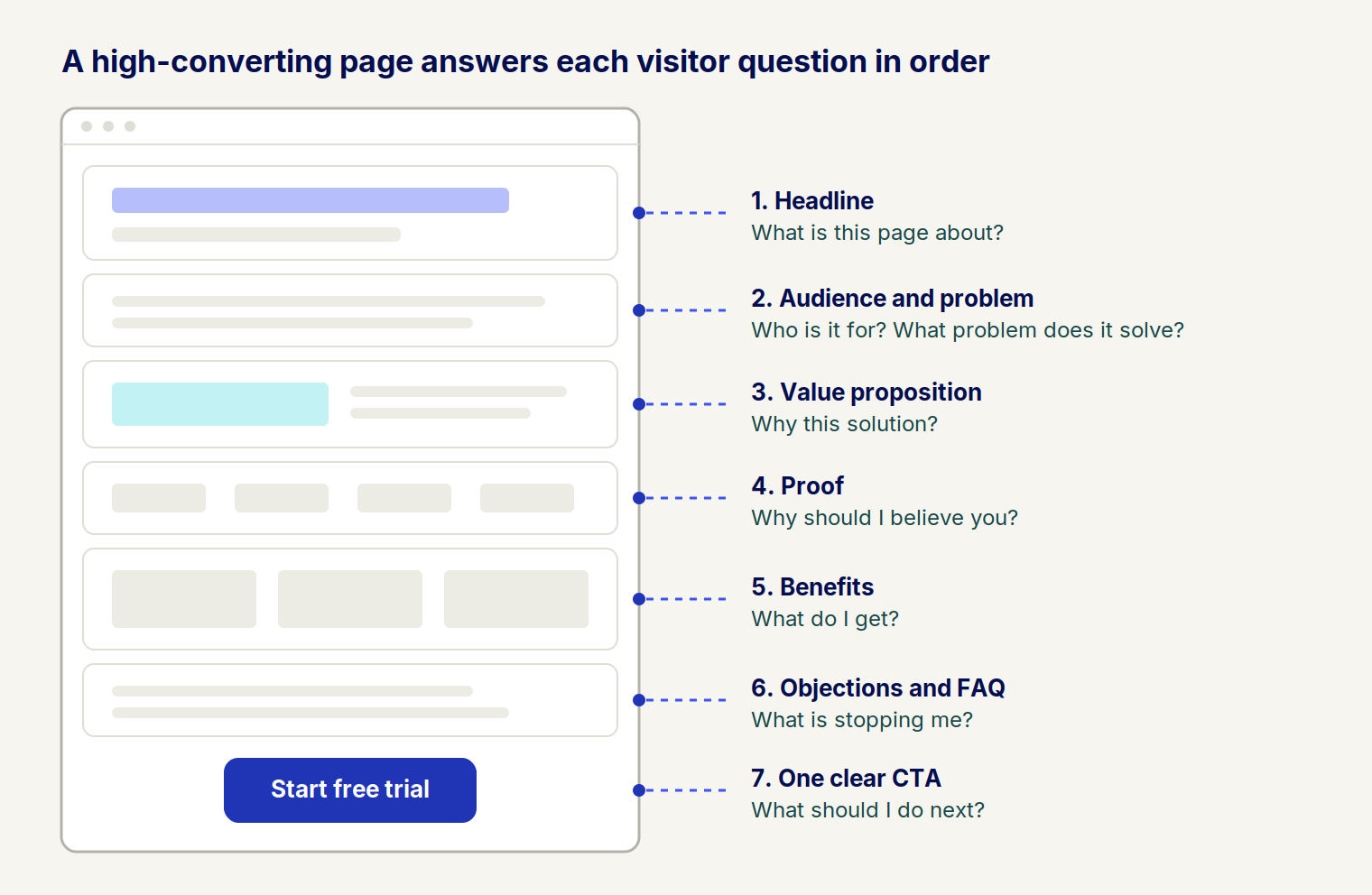
Forget the idea of a special “AI landing page.” Build a page that’s exceptionally clear to people, and it will be clearer to the systems reading it too. A strong campaign page makes six things obvious:
- What is this page about? The headline states the core value proposition.
- Who is it for? Visitors recognize themselves or their use case.
- What problem does it solve? The product connects to an outcome.
- Why should I believe you? Proof: customers, data, reviews, demos.
- Why this solution? A clear reason your approach is worth choosing.
- What should I do next? One obvious CTA.
Need a starting point? Instapage’s AI Content generator can draft headlines, paragraphs, and CTAs right in the builder, so you can test different value propositions without starting from a blank page.
Don’t turn your landing pages into SEO essays
Here’s the trap. If marketers hear that AI systems need context, they start piling text onto every page. That’s not the answer. Google says there’s no ideal page length, and a landing page shouldn’t become a 3,000-word article because someone thinks AI prefers long content.
Ask instead: what does this visitor need to feel confident taking the next step? That might be:
- a clear value proposition
- relevant benefits
- proof and customer results
- examples or use cases
- pricing information
- integrations and security details
- answers to objections
- a clear CTA
The goal isn’t maximum content. It’s minimum uncertainty. If you want a structured way to check, run your page through our 100-point landing page audit checklist.
Give search engines and customers something worth remembering
AI makes one thing obvious: commodity content is easy to reproduce. Original insight isn’t.
If your article summarizes what already exists on hundreds of sites, there’s little reason for anyone, or any AI system, to reference it. Google’s guidance favors original information, research, analysis, and first-hand expertise. The strongest content isn’t the one with the most keywords. It’s the one with something to add:
- Original research: analyze campaign or conversion data and publish the findings.
- First-hand experiments: show what happened when you changed a headline, offer, or CTA.
- Real examples: break down actual campaigns and why they worked.
- Practical frameworks: give marketers a model they can apply themselves.
- Original benchmarks: help marketers understand what good performance looks like.
Don’t create content just because an AI can summarize it. Create content that gives people a reason to seek you out.
AI search and paid search aren’t competitors
It’s tempting to see AI search as a threat to paid search. You don’t have to choose. Paid search captures existing demand. Organic search captures people researching problems. AI search introduces people to brands while they explore.
The real question for a modern marketing team is: what happens to the visitor after each channel sends them to you?

Measure what happens after the click
Marketers want to know whether they show up in AI answers. That’s a useful signal, but it isn’t the goal. Think of the journey as:
Visibility → Click → Engagement → Conversion → Pipeline → Revenue
An AI mention that sends no qualified traffic isn’t worth much. A small number of relevant visitors who convert can be worth a lot.
So track search visibility, but connect it to what happens on the page:
- Tag your traffic. Add UTM parameters to links you control so sessions and leads can be attributed in your analytics, like GA4, and in your CRM.
- Capture the source with the lead. Use hidden form fields in Instapage to pass UTM values into your CRM alongside every submission.
- Test what you learn. Use Instapage Experimentation to A/B test the headline, proof, or CTA for each audience, and let conversion data, not opinion, pick the winner.
- See how people behave. Use heatmaps to find where visitors stop scrolling or ignore your CTA. Our guide on how to use heatmaps walks through it.
The question that matters stays the same: did discovery lead to a valuable customer interaction?
The biggest AI search mistake marketers make
Optimizing for the machine instead of becoming more useful to the customer.
There’s no AI search shortcut that replaces strong SEO, useful content, technical accessibility, and a good page experience. So don’t build 100 pages because an AI tool spun 100 variations of one keyword. Don’t pad articles with filler sections. Don’t create an llms.txt file and assume you’ve solved AI search. And don’t chase mentions for their own sake.
Instead:
- Answer important questions.
- Bring original evidence.
- Show real expertise.
- Build experiences that match intent.
- Make your pages easy to understand, for people and machines.
- Measure what happens after the click.
That strategy survives algorithm changes.
Frequently asked questions
Does AI search replace SEO?
No. Google says its AI features in Search, including AI Overviews and AI Mode, are built on its core Search systems. Foundational SEO still applies.
Do I need a separate landing page for AI search traffic?
Not necessarily. Focus on the intent behind the visit and deliver the most relevant experience. A research article and a conversion-focused landing page can play different roles in the same journey.
Should I write longer content to rank in AI search?
No. Google says there’s no ideal page length. Write enough to fully answer the visitor’s question and remove doubt, then stop.
Do I need special AI markup or an llms.txt file?
Not for Google. There’s no AI-specific file or markup required to appear in Google’s AI features. Standard structured data is still worth adding, because it helps search systems understand your page. In Instapage, you can generate and validate schema markup from any page’s SEO settings.
How do I measure AI search traffic?
Look beyond visibility. Track clicks, engagement, conversions, pipeline, and revenue. Google Search Console includes AI feature traffic in its Performance report, so use it alongside your analytics, UTM tracking, and CRM data.
The takeaway
AI search changes how people discover information. It doesn’t change the core marketing problem: can you turn intent into action?
The brands that win won’t just be the ones that appear in an AI answer. They’ll be the ones that are useful during discovery, earn the click, deliver a relevant page, and make the next decision easy.
The content earns discovery. The evidence earns trust. The landing page earns action. And experimentation makes the whole system better over time.
Search gets someone to the door. The experience decides whether they walk through it.
Ready to turn more AI search traffic into conversions? Build, personalize, test, and optimize every campaign page with Instapage. Start your free 14-day trial →
